I was very fortunate to participate in yesterday's VII International Seminary "Digital Brain". It happened in Lima, Peru and it was organized by Cerebrum (Neuroscience, Education and Human Development) a very active and renowned organization in charge of spreading knowledge and best educational practices based on neuroscience, pedagogy and psychology investigations. There were two speakers, Anna Lucia Campos and Gary Small, MD (www.drgarysmall.com), a world renowned neuroscientist with lots of publications on topics such as: nuerology, psychiatry, memory, brain and Alzheimer Disease.
During their presentations lots of interesting facts, investigations and proposals were considered. the best of all is that it changed the way I think about exposing young children to technology and the newest gadgets. For some of the comments from the presentations follow the hashtags: #CerebroDigital and #DigitalBrain in Twitter, or go to Cerebrum's twitter account: http://twitter.com/cerebrumdigital.
Even more by the fact that I saw some of Sugata Mitra's videos and investigations to ask myself a question: Should we radically change the way we teach and expose children to technology?
Take a few minutes by watching these videos, and help me answer that question:
A few days ago I had to give my last presentation at my MEd class. It was a great experience. Not only because it marked the end of a very important step in my professional development, but also because it was achieving a 2-year program that had to fit into a very busy schedule.
In terms of learning I had a great deal of it, personally and as a member of a great group of professionals of different areas (interpreter/translator, librarian, teachers, dentists, police men, linguist, lawyer, graphic designer, and me, a biologist turned educator). The perspective to see many things was very rich coming from such a diverse group.
My last presentation was about the education in the future, in order to prepare for that I had to review a large amount of information from the past and try to set one of the possible scenarios for the near future of education, I don't think anybody can accurately predict the long term future of education, changes are too rapid and technologically strong to predict something for more than 15 years.
It was undeniable for me to foresee, as many others have done that the way we assess and evaluate students will not serve a real purpose in the long run. We´ve been assessing students' knowledge based on the amount of information they can remember. That might have been useful before, but nowadays anybody with internet access can have access to almost infinite amounts of information. Definetely, that is not the ideal way we want to make sure we're educating our students right. It is not how much information they may remember or memorize, it is what they can learn, create or produce from it that really matters.
The following video is a great way to see that, it is an experience called I Scientist in the UK:
The following video speaks for itself, let's democratize education and have mistakes being a part of the learning process.
These are some of the words I could type in my iPod while I was reading about learning theories and i think it's useful for my thesis that tries to link use of technology with learning strategies: Education in the 21st century must not be restricted to theoretical and abstract knowledge acquisition. It is imperative to put even more emphasis in skills that promote obtaining, selecting and analysis of large quantities of information in short periods of time.
Learning must be active in the sense that any learner must have the capacity to take informed but fast decisions based on vast amounts of information presented in different formats, in order to produce analytical comments and recommendations presented in visually-frienly and attractive formats. Learning must be based on training of skills on the move, and the evaluation methods must be modified from assessing the amount of processes in what Vigoysky calls, the Zone of Real Development, and the Zone of Proximal Development. This is of great importance due to the fact that the amount of information available to anybody with Internet access is practically infinite. It would be counterproductive to pretend that society can determine the professionalism of a person, or the academic or developmental potential of an individual based solely on the amount of knowledge already acquired, instead of the potential production and creative solutions that individuals can provide if learning skills are directed and trained.
These skills are hardly obtained if the student is left untrained. And it is in this part where today's students are found in significant amounts. The economic constraints in developing countries imposed by superficial needs to follow the lifestyle of developed countries, obliges parents to maintain more than one job at the same time, leaving young students (teenagers) at the will of mass communication media and their own to overcome the academic exigencies imposed by public and private schools.
Once these young students are left alone or minimally supervised at home, they are prone to the actions of a massive avalanche of information that demands the information user to be developmentally mature, a blending between the concrete and abstract operational stages described by the famous psychologist Jean Piaget decades ago. It is the formation of the personality, organizational skills and academic goals,or their absence what will determine the perspective and desire of learning for the future life of young students.
The essential skills to be developed have to cover these gaps of parental attention and circumstancial solitude facing the academic demands. Cognitive and metacognitive skills, in that order take years of academic training, usually obtained in the years spent in higher education. However, the cultural, economic and technological demands require education to be oriented towards the formation of an individual with order, positive attitude and ambitious goals supported by a solid academic basis.
Based on Vigotsky's theory, the proximal area of development is the area that 21st century education must concentrate its efforts, because it is now impossible to sum up information and knowledge as could be done only a few decades ago. The amount of information is doubling in less than 5 years already, this infinite amount of information could not be acquired using traditional educational methods, mostly based on memorization and classic repetition of information. It is the intense training of cognitive and metacognitive skills in conjuction with clear practical applications to what is being learned, bringing real-life applications to my class and out of it.
Every single day, 350+ million users access Facebook, a slightly less number of users communicate by 140-character messages via Twitter, and others exchange info, feelings and messages via hi5, MySpace, MSN Messenger, etc.
It is easy to understand the explosion in Social Media in the last few years, Communication is innate and inherent to humans, and language is its highest expression, and humans have perfected it.
I started on Twitter last year, and ever since I’ve tweeted over a thousand times, and for sure I’ve read over 100,000 tweets already. Growing in Social Media is as exponential as bacterial growth, unstoppable.
Demographics depend on the type of Social Media you are inquiring about, but in general terms most internet users have experienced it in one way or another.
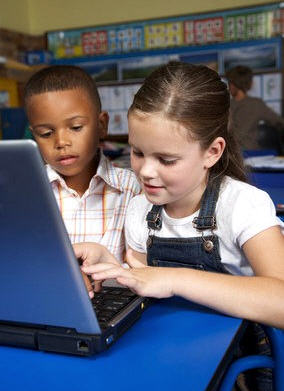
However, one thing is certain, kids love social media, and they are the fastest growing demographic group showing presence in these websites. So, how does that translate into something to be used in education?
Well, it is necessary to be able to get into Social Media as well, as teachers and administrators, we must be facilitators (unintended rhyme) and not scared away from it, and less of all…forbid it.
Digital Natives are anew generation, and as much as we want to categorize them as ADD or ADHD kids, they are multitaskers. I’m sure there will be a significant change in appreciation in the still valid idea that women are true and efficient multi-taskers, and men aren’t. In the near future, kids and teens will have to be occupying that perception.
How’s the behavior of our kids’ and teens’ right now? We can certainly verify it by watching this video and identifying our son, daughter, niece or nephew:
M(2) Video
The report published by the Kaiser Family Foundation, indicates numbers that are completely true. Usage of media has increased to 10 hours and 29 minutes in 2009, discounting the multi-tasking time (29%) we reach to 7 hours and 38 minutes a day.
So, kids are “working” a whole shift in total media (Tv, internet, music, games, etc.) Wouldn’t it be productive for teachers to insert knowledge acquisition and learning enhancement activities in such shift?
What does that indicate? We have to adapt! Adaptation is a human characteristic, and one that we need to use a lot in this case.
How will be the Web of Tomorrow? Simple answers: more portable, smaller, easier to use, ubiquitous, and easier to integrate to any of our daily devices and appliances.
I always go back to Sir Ken Robinson and his TED conference when dealing with questions about Education, and this time is not the exception. Creativity in Education is something we must constantly go back to as a reference point, but also as a stimulus for learners and teachers.
It sounds ironic when you say that you miss work. Especially when you are a few days from your time off work, enjoying the holidays. However, as much as I want to rest and have fun with my family, can I stop working? Or, at least, can I stop searching for resources and new things to offer in and out of the classroom? Yes! Vacations all summer, woohoo!!!........not really. I guess that's the fine print when you sign the professional contract to become an educator (working 8 hours at school and several more at home). I didn't leave for vacation time and I can't stop working about the curricular challenges for 2009. My country's academic year runs from march to december. So the holidays mark the end of the academic year too. I tried to stay away from my tools of research: twitter, ning, monitter, etc. But, even though disconnected for a while, I know I can't get too far from from it. The rest of the world is learning and teaching at all times. I use lots of videos in my classes, I found the next video from daibarnes at twitter. The US spends thousands of dollars per student every year, my country barely spends tens of dollars per student every year, and I think bioth have similar results in primary and secondary schools. This is no irony, it is a reality. Something that we have to face and that we must change. The world says technology is the solution. I'm a huge fan of technology, I use it in all my classes, but I think technology alone is not the solution. We must not rely solely on that. The contribution that parents bring to students' performance when they get involved in their education is incomparable. Get involved in your children's education and you'll see that education and many other areas of interest in their lives will improve.
I remember reading about serious green movements in the early 90's when I was coming out of my teenage years. It sounded as the right thing to do, but how much have we done ever since? Buty "we" I mean us, society, you, me and everybody else. Governments sign agreements, treaties, one less respected than others. As with any other world topic, it is subjected to politics but, in this case, mainly to economics. Yes because it is the money the ruler of any movement right or wrong trying to save our planet.
All of this made me think, how are my two children going to live in this world. When they turn 25, the world's population will be around 9 billion people, and I'm sure the oil will still be driving the economy, but it will have a very strong competitor, water.
Yes, water shortage is a reality. and not a projection. Not in vane "Thirst" was the winner of the SlideShare annual contest, because it is something we are living, not something we're hypothesizing.
It's been only 4 months since I came into this world, yes into the eLearning, Web 2.0, Teacher 2.0, world. It all came amazingly fast to me. I started working in St. George's College in february of this year, and from there on my appreciation on technological tools changed dramatically. I didn't have a blog or a wiki before. Now I have 2 blogs and 2 wikis. The Wikis I've prepared are mostly dedicated to class contents, dates, homeworks, assignments, deadlines, etc. The blogs are focused into something fresh. Something you can read if you're interested in Science or any topic of significant cultural or academic impact. My first Wiki is a dedicated, and very useful and powerful tool that allows me to extend the communication I have with my students, but also with their parents. That's one of the powerful parts. Although I have to recognize it was not easy to introduce students...and parents into this "new" technology. Even though Blogs and Wikis are not new, in computer time, they are still entering into the Educational world, faster and faster everyday. The most difficult part was to let people open their eyes, including myself, to an endless list of possible resources, techniques, designs, and content that was usually reserved for elite populations. that's the beauty of it, knowledge has entered into a real democracy, anyone with an internet connection has access to a limitless amount of information. All you need to KNOW is that the resources are there for you to start using them and exploiting them, at home, at work and now, in classrooms. Although it is extremely important that facing such an immense flow of information we must FILTER that information, because not everything will be useful for you at the same time. My students from lower 5th grade up to middle 1st grade (5th to 7th grade) have learned in the past 3 months to deal with Interactive SMART Boards, Notebook presentations, Issuu displays, PDF documents, Flash Animations, Inserted Images and Videos, Blogs, Wikis, and Podcast. Three months ago they were not used to this, nowadays they demand that from me. They request that I publish classes and information faster. I don't know how this will keep changing and evolving, but one thing is certain, it is here we might as well use it or, our student will leave us behind sooner or later.




 Posts
Posts





 Linkedin/glazaro
 Twitter/glazaro
 YouTube/sjtics
 Del.icio.us/glazaro
 Skype/glazaro
 Technorati/glazaro
 MyBlogLog/glazaro
 Blog/Gerardo Lazaro
 Blogger/glazaro@sanjorge.edu.pe


